































































































































Table of Contents
Toggle12 Natural Teeth Whitening Home Remedies: What Works & What to Avoid
Author: RVLNSV PRASAD
Updated On: September 2026
About Us
Author Bio
Editorial Policy
Contact Us
Quick Answer
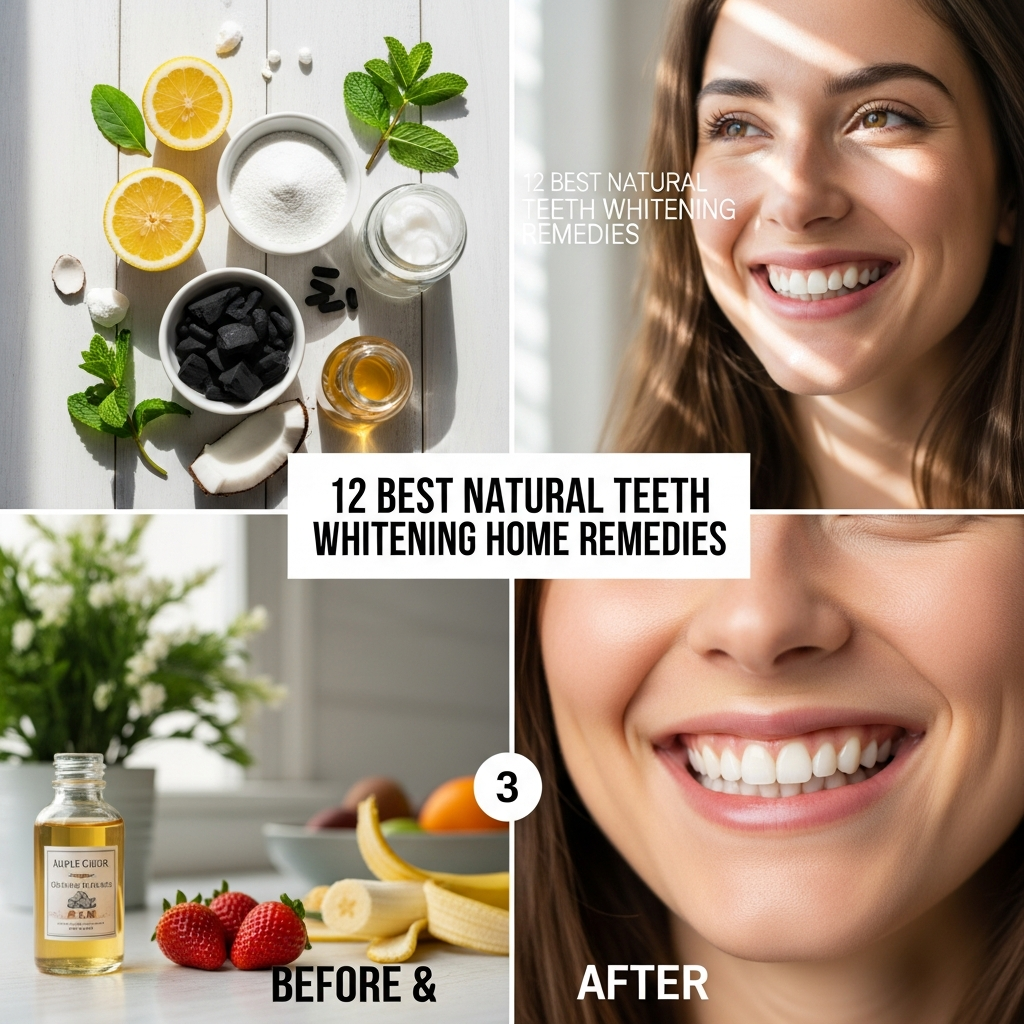
Natural teeth whitening home remedies can make teeth look cleaner and brighter, but they do not all work in the same way.
Some approaches mainly help remove surface stains. Others are simply popular online without good evidence that they actually whiten teeth. A few DIY methods can expose enamel and gums to unnecessary abrasion or acids.
The most useful natural approach is therefore not to search for the strongest kitchen ingredient. It is to understand why your teeth look darker, reduce new staining, maintain good oral hygiene, and avoid methods that could damage enamel.
The American Dental Association (ADA) explains that whitening toothpastes primarily help remove extrinsic surface stains, while peroxide-based products can chemically lighten tooth color. The ADA also notes that evidence for many DIY or “natural” whitening techniques is limited. American Dental Association: Whitening
Introduction
A brighter smile does not necessarily require an aggressive whitening routine.
Sometimes teeth look dull because coffee, tea, tobacco, or other pigmented foods have left stains on the surface. In other cases, the natural color of the tooth has changed with age, or the discoloration comes from inside the tooth.
That distinction is important.
When I first became interested in natural teeth whitening, I thought the main question was
“Which home remedy whitens teeth fastest?”
I now think the better question is
“What is making the teeth look darker, and can I improve their appearance without damaging the enamel?”
That change in perspective matters because cleaner-looking teeth and chemically bleached teeth are not the same thing.
The ADA explains that whitening toothpastes mainly work through mechanical removal of extrinsic stains, while peroxide-based bleaching products can lighten tooth color through a chemical process. American Dental Association: Whitening and bleaching explained
This article takes a practical approach to natural teeth-whitening home remedies. Instead of presenting every viral recipe as effective, it separates useful stain-control habits from popular methods that have limited evidence or potential drawbacks.
Medical disclaimer: This article is for general education and does not replace an examination or personalized advice from a dentist. Tooth discoloration can sometimes be related to decay, trauma, medication, enamel changes, or another dental condition.
Key Takeaways
- Natural tooth color varies between people.
- Coffee, tea, tobacco, and other pigmented substances can contribute to surface staining. ADA guidance on tooth whitening
- Aging can make teeth appear yellower because enamel becomes more translucent and the underlying dentin becomes more visible. Cleveland Clinic: Tooth discoloration
- Good brushing and cleaning between teeth are more important than any DIY whitening trick.
- Whitening toothpastes can help with surface stains, but they are not the same as bleaching treatments. ADA: Whitening toothpastes and bleaching
- There is no reliable scientific evidence that oil pulling whitens teeth. ADA News: Oil-pulling evidence
- Evidence for charcoal-based whitening is insufficient, and abrasion is a concern. ADA: Whitening evidence and DIY methods
- Acidic DIY methods such as lemon and vinegar are not sensible routine whitening choices.
- Sudden or localized discoloration deserves dental assessment rather than another home remedy.
- Professional whitening and properly formulated at-home bleaching products work differently from ordinary stain removal. ADA: Whitening
Why Teeth Become Yellow or Darker
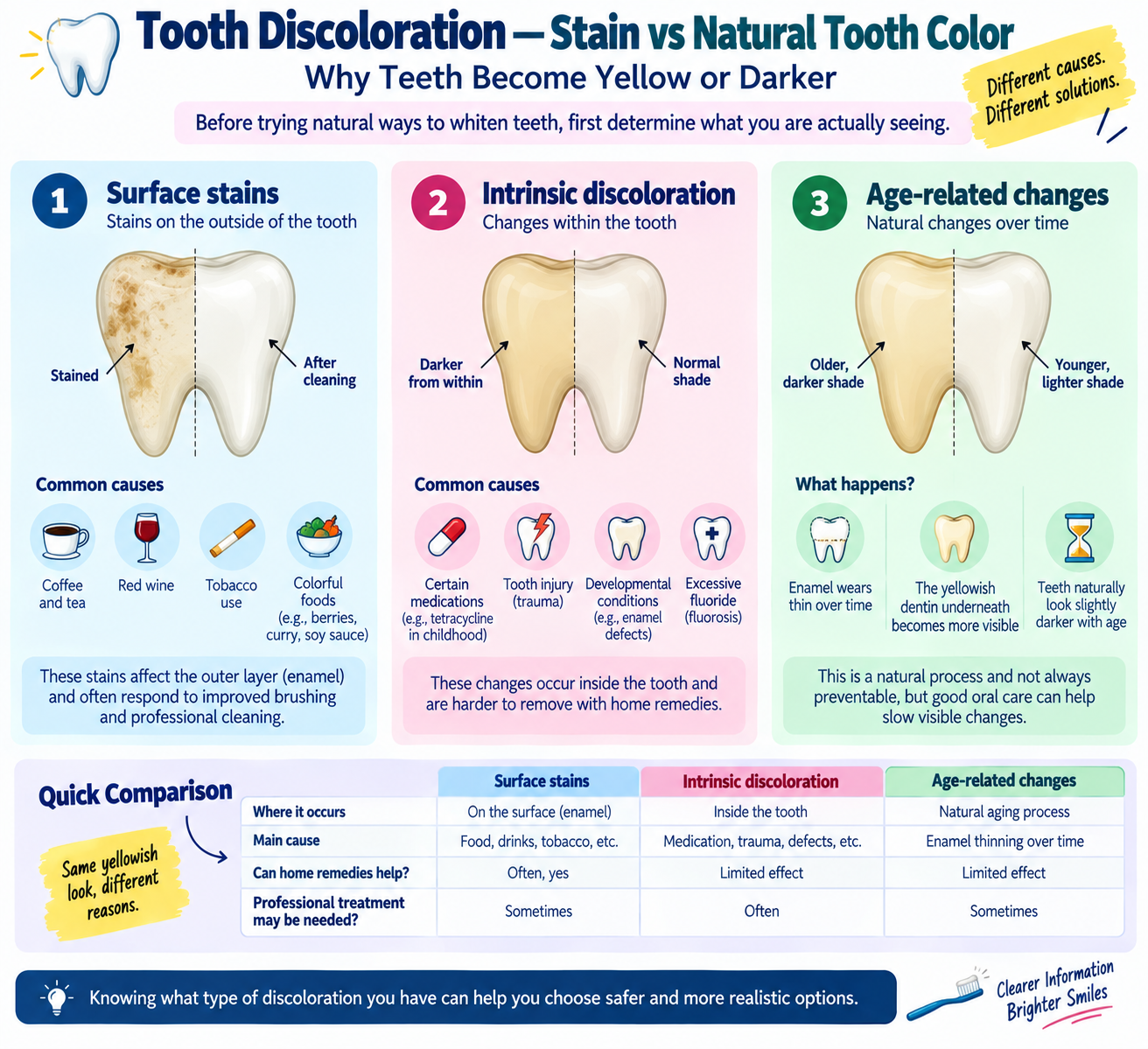
Before trying natural ways to whiten teeth, first determine what you are actually seeing.
Teeth are not naturally bright white for everyone. Their appearance is influenced by enamel thickness, dentin color, age, genetics, and staining.
Surface stains
Surface or extrinsic stains occur on the outside of the tooth.
Common contributors include:
- Coffee
- Tea
- Tobacco
- Red wine
- Cola
- Strongly pigmented foods
- Plaque buildup
- Poor oral hygiene
The ADA identifies foods, beverages, tobacco, and other external factors as contributors to extrinsic discoloration. American Dental Association: Tooth whitening causes and treatment
These are the stains most likely to respond to cleaning and stain-removing toothpaste.
Aging
Teeth can naturally look darker as people age.
Enamel becomes thinner and more translucent over time, allowing more of the naturally yellowish dentin underneath to show through. Cleveland Clinic: Tooth discoloration
This is one reason natural remedies cannot always transform naturally yellow teeth into an extremely white shade.
Internal discoloration
Some discoloration develops within the tooth rather than simply sitting on its surface.
Trauma, certain medications, developmental conditions, and other dental factors can contribute to intrinsic discoloration. Cleveland Clinic: Tooth discoloration
That type of problem requires a different approach.
A useful distinction
| What you notice | Possible reason | Sensible first step |
|---|---|---|
| Several teeth look dull. | Surface staining | Improve oral hygiene and stain control. |
| Coffee or tea stains | Extrinsic staining | Reduce exposure and clean regularly. |
| Gradual yellowing with age | Natural dentin showing through | Set realistic expectations. |
| One tooth suddenly turns gray. | Possible internal change or trauma | Dental examination |
| Dark area with pain | Possible dental disease | Prompt dental evaluation |
| White, brown, or unusual patches | Several possible causes | Dentist assessment |
The important lesson is simple:
Not every discoloration is a whitening problem.
My Personal Experience With Natural Teeth Whitening
My interest in natural teeth whitening started with something ordinary.
I noticed that my teeth looked less bright during periods when I was drinking more coffee.
My first instinct was to find something stronger that could make them white quickly.
That approach was not particularly helpful.
I eventually paid more attention to the habits creating the stains, how consistently I was cleaning my teeth, and which online whitening methods were actually supported by evidence.
That changed my perspective.
I learned that removing surface stains is different from bleaching the natural color of a tooth.
The ADA makes the same distinction: whitening toothpastes primarily remove extrinsic stains, whereas peroxide-based bleaching products can lighten tooth color. ADA explanation of whitening versus stain removal
My experience is personal and should not be interpreted as clinical evidence. A method that appears helpful to one person may not be appropriate for someone with sensitivity, enamel problems, cavities, gum disease, or another dental condition.
1. Improve Your Brushing Routine
This is not an exciting “hack,” but it may be one of the most useful natural ways to keep teeth looking cleaner.
The ADA recommends brushing twice a day for two minutes with fluoride toothpaste. ADA: Home oral care recommendations
Regular brushing helps control plaque and supports cavity prevention.
If your teeth look dull because plaque and surface deposits have accumulated, improving your routine may make a visible difference without experimenting with harsh ingredients.
A practical routine
- Brush twice daily.
- Use fluoride toothpaste.
- Spend about two minutes brushing.
- Avoid aggressive scrubbing.
- Clean between your teeth regularly.
- Replace worn toothbrushes or brush heads.
The objective is not to scrub away the natural tooth.
It is to remove plaque and external deposits while protecting the enamel.
2. Consider a Whitening Toothpaste for Surface Stains
Whitening toothpaste is often misunderstood.
It is not necessarily a miniature version of professional bleaching.
The ADA explains that whitening toothpastes primarily rely on abrasives to mechanically remove extrinsic surface stains, although some formulations also contain low levels of peroxide. ADA: Whitening toothpaste evidence
That makes this option more relevant if your problem is coffee or tea staining rather than your natural tooth color.
If you choose one, follow the product directions and avoid assuming that more brushing pressure will produce better results.
More abrasion does not automatically mean more whitening.
3. Reduce the Habits That Create New Stains
This is one of the most overlooked approaches to natural teeth whitening.
Imagine repeatedly staining your teeth with coffee and then trying to remove the stains with increasingly aggressive methods.
You are solving the consequence while continuing the cause.
You do not necessarily have to eliminate coffee or tea.
Instead:
- Drink water afterward.
- Avoid continuously sipping staining drinks throughout the day.
- Maintain regular brushing.
- Reduce tobacco exposure.
- Keep regular dental appointments.
The ADA lists coffee, tea, tobacco, and other external factors among contributors to tooth discoloration. ADA: Causes of tooth discoloration
This prevention-first approach is one of the safest natural ways to whiten teeth because it focuses on reducing the amount of new staining.
4. Drink Water After Coffee or Tea
Water is not a bleaching agent.
It will not change the internal color of your teeth.
But drinking water after staining foods or beverages is a simple habit that can help keep the mouth cleaner and reduce the amount of time staining substances remain in contact with the teeth.
The ADA’s natural-whitening guidance also emphasizes everyday habits such as limiting staining foods and beverages and maintaining good oral hygiene. ADA MouthHealthy: Natural Teeth Whitening
Think of water as stain management, not whitening chemistry.
5. Eat a Balanced Diet Instead of Chasing “Whitening Foods”
There is no food that can magically bleach teeth.
Apples, carrots, celery, dairy products, and other foods are sometimes marketed as natural teeth cleaners or whiteners.
It is more accurate to consider them part of a balanced diet rather than replacements for brushing.
Crunchy foods do not replace a toothbrush.
Cheese does not bleach enamel.
Fruit does not erase deep discoloration.
A healthy diet supports general health, while good oral hygiene remains the foundation of dental care.
6. Oil Pulling: Popular, But Not Proven to Whiten Teeth
Oil pulling is one of the most widely promoted natural teeth-whitening home remedies.
It involves swishing edible oil around the mouth and then spitting it out.
The practice has traditional roots, but evidence is a different matter.
The ADA states that there are no reliable scientific studies showing that oil pulling whitens teeth or improves oral health and well-being. ADA News: Oil pulling and the evidence
The ADA’s MouthHealthy resource reaches the same conclusion about oil pulling and whitening. ADA MouthHealthy: Natural Teeth Whitening
Therefore, I would not describe oil pulling as a proven natural whitening treatment.
If someone chooses to do it, it should never replace brushing, cleaning between teeth, or dental care.
7. Baking Soda: Understand What It Can Actually Do
Baking soda appears in many whitening discussions because it has abrasive cleaning properties.
The important distinction is between a professionally formulated toothpaste containing baking soda and repeatedly scrubbing teeth with homemade powder.
The ADA explains that whitening toothpastes can remove extrinsic stains through abrasive action. ADA: Whitening toothpaste and surface stains
That does not mean that stronger DIY abrasion is better.
If you like baking soda toothpaste, a formulated oral-care product is a more sensible choice than creating increasingly abrasive homemade recipes.
8. Hydrogen Peroxide: Real Whitening Chemistry, Poor DIY Experiment
Hydrogen peroxide is not simply an internet myth.
Peroxide is genuinely used in dental whitening products.
The ADA identifies hydrogen peroxide and carbamide peroxide as commonly used bleaching agents. ADA: Peroxide-based tooth whitening
But this does not mean that mixing household peroxide with water and using it as a homemade mouth rinse is a good whitening strategy.
Concentration, exposure time, formulation, existing dental health, and individual sensitivity all matter.
The ADA also identifies temporary tooth sensitivity and gum irritation as common adverse effects of vital tooth whitening. ADA: Whitening risks and side effects
A 2025 systematic review also found that higher concentrations of at-home bleaching agents may increase sensitivity risk, although the overall evidence quality was low. PubMed: 2025 systematic review of at-home bleaching and sensitivity
For that reason, I would not recommend homemade peroxide recipes.
If you want peroxide whitening, use an appropriately formulated product according to its instructions or discuss professional options with a dentist.
9. Skip Lemon Juice Whitening
Lemon juice is one of the most common internet suggestions for natural whitening.
The fact that it is natural does not make it suitable for teeth.
Acid exposure is precisely the kind of thing you should be cautious about when your goal is to preserve enamel.
The ADA specifically includes acid-containing fruits among DIY whitening approaches for which evidence and safety are concerns. ADA: DIY natural whitening methods
The ADA has also warned against lemon-juice whitening among harmful social media dental trends. ADA News: Dental trends that can cause harm
My recommendation is simple:
Do not use lemon juice as a teeth-whitening treatment.
10. Avoid Apple Cider Vinegar as a Whitening Rinse
Apple cider vinegar is another popular DIY method.
But vinegar is acidic, and repeatedly exposing teeth to acidic substances is not a sensible way to pursue a brighter smile.
The goal should be to improve appearance without sacrificing tooth structure.
For that reason, I would not recommend apple cider vinegar as a routine whitening mouth rinse.
If your teeth become sensitive after using acidic home remedies, stop the practice and seek dental advice if the symptoms persist.
11. Activated Charcoal Is Not the Miracle Whitening Ingredient Social Media Suggests
Activated charcoal became popular partly because the black color creates a dramatic visual contrast.
But appearance on a toothbrush or in a video is not evidence of effective whitening.
The ADA states that there is insufficient evidence demonstrating that charcoal-based oral-care products provide measurable whitening benefits with adequate safety and effectiveness. ADA: Evidence on charcoal whitening
The ADA has also warned that charcoal can be abrasive and may wear enamel over time. ADA News: Social-media dental trends
So I would not rank activated charcoal among the best natural teeth whitening methods.
12. Professional Dental Cleaning Can Sometimes Do More Than Another Home Remedy
Sometimes the most useful “natural whitening” step is to stop trying to whiten and have the teeth properly evaluated.
Plaque can harden into calculus, and home brushing cannot simply remove hardened deposits.
A dental professional can examine the discoloration and determine whether you are dealing with:
- Surface staining
- Calculus
- Tooth decay
- Trauma
- Internal discoloration
- Enamel changes
- Another dental condition
The ADA recognizes professional cleaning as a way of addressing extrinsic stains. ADA: Whitening and extrinsic stains
This leads to an important distinction:
Cleaning removes deposits and surface stains.
Bleaching changes tooth color.
They are not the same treatment.
What Actually Works for Natural Teeth Whitening?
| Method | What it mainly does | Evidence | My assessment |
|---|---|---|---|
| Fluoride toothpaste + brushing | Controls plaque and supports oral health | Strong | Essential |
| Whitening toothpaste | Helps remove surface stains | Supported | Reasonable |
| Water after staining drinks | Helps with stain-control habits | Practical | Useful |
| Reducing tobacco/staining drinks | Prevents new staining | Strongly relevant | High value |
| Professional cleaning | Removes deposits and surface stains | Established dental practice | Useful when needed |
| Oil pulling | Popular traditional practice | No reliable whitening evidence | Don’t rely on it |
| Baking-soda toothpaste | Surface stain removal | Supported in formulated toothpaste | Reasonable |
| Charcoal | Marketed for whitening | Insufficient evidence | Avoid relying on it |
| Lemon juice | Acidic DIY method | Poor choice | Avoid |
| Vinegar | Acidic DIY method | Poor choice | Avoid |
| Homemade peroxide rinse | Attempted bleaching | Safety depends on formulation/concentration. | Don’t improvise. |
| Dentist-guided whitening | Bleaches tooth color. | Established evidence | Consider when appropriate. |
The ADA’s own natural-whitening guidance emphasizes everyday habits such as brushing twice daily, cleaning between teeth, limiting staining foods and drinks, avoiding tobacco, and regular dental visits. ADA MouthHealthy: Natural Teeth Whitening
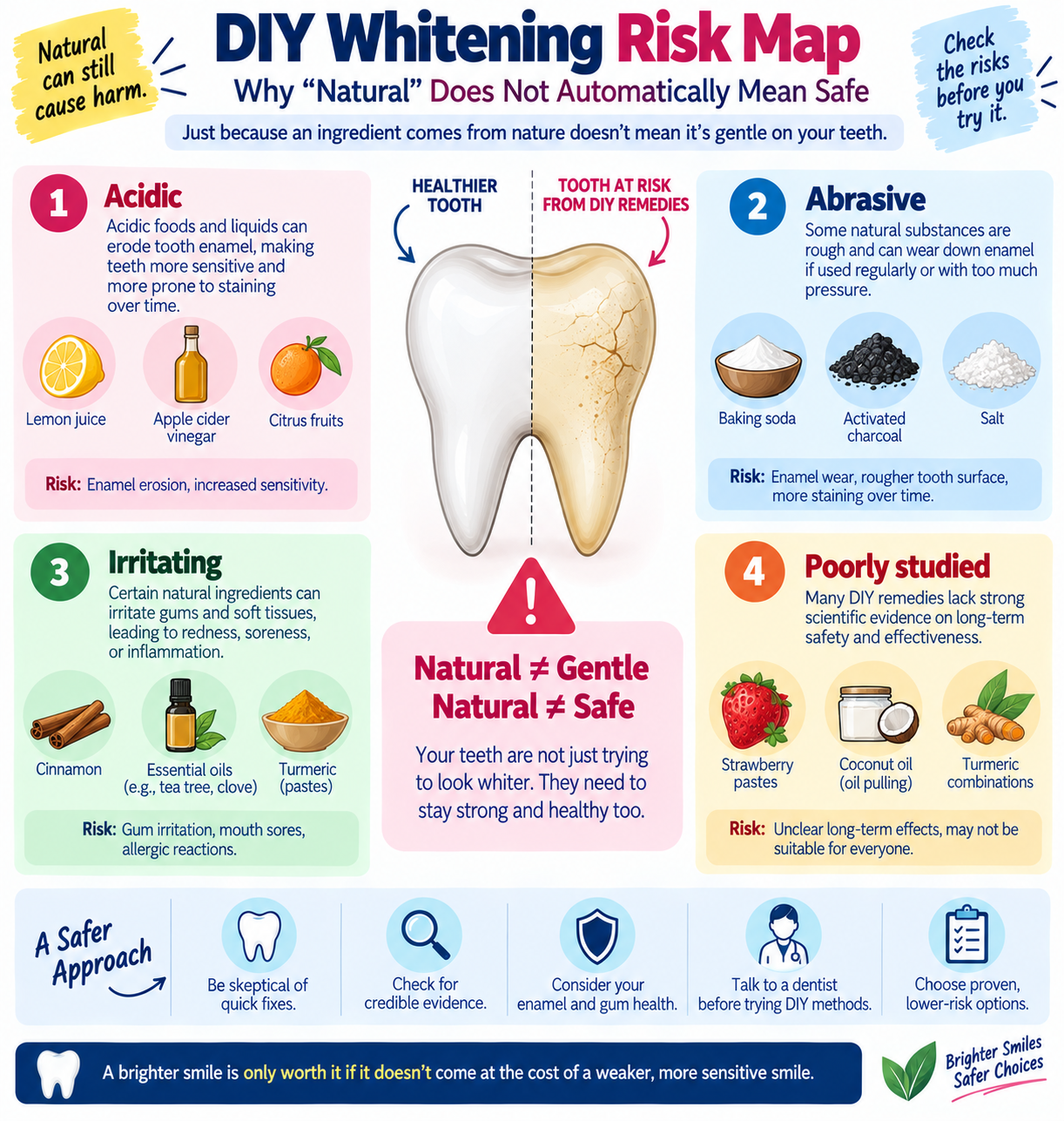
Why “Natural” Does Not Automatically Mean Safe
This is probably the most important lesson in the entire topic.
People often assume:
Natural = gentle = safe
That equation is false.
A natural ingredient can be:
- Acidic
- Abrasive
- Irritating
- Poorly studied
- Unsuitable for damaged enamel
- Unsafe when swallowed
- Inappropriate for an existing dental problem
The ADA warns that DIY dental trends can range from ineffective to harmful and specifically cautions against several popular natural-whitening approaches. ADA MouthHealthy: Dental trends and DIY whitening
A better rule is
Judge a whitening method by evidence and safety—not by whether the ingredient comes from your kitchen.
A Simple Decision Guide Before Trying Any Home Remedy
Ask yourself:
Is the discoloration new?
A sudden change deserves more attention than gradual staining.
Is only one tooth affected?
A single dark tooth can have a different cause from generalized coffee staining.
Is there pain or sensitivity?
If a tooth hurts, whitening should not be your first priority.
Does the remedy use acid?
If yes, think carefully about enamel protection.
Is it highly abrasive?
More abrasion does not mean safer whitening.
Am I trying to remove a surface stain or change natural tooth color?
That question alone can prevent many unrealistic expectations.
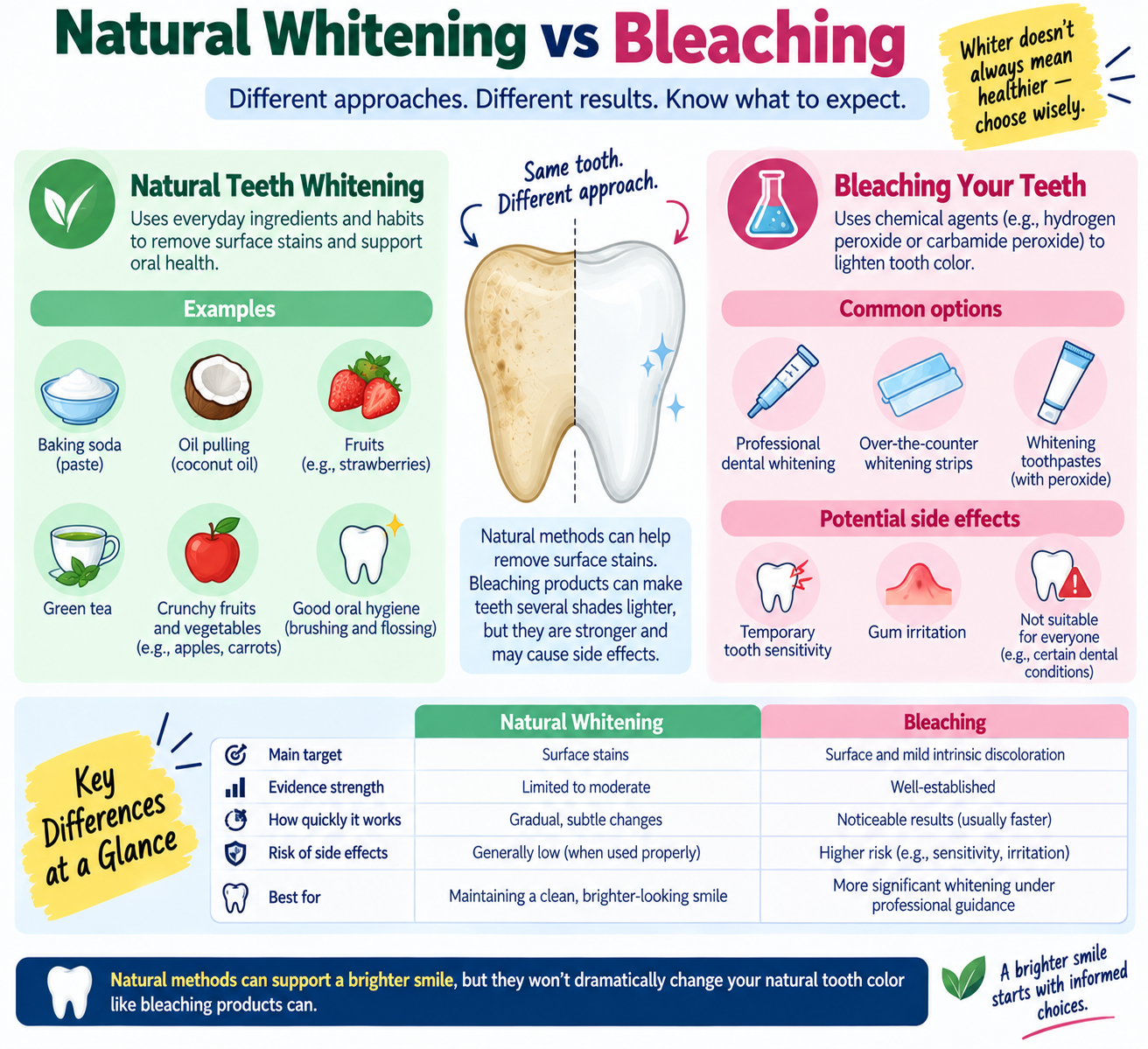
Natural Stain Control vs. Professional Whitening
| Feature | Natural stain-control approach | Professional or dentist-guided whitening |
|---|---|---|
| Main goal | Reduce external staining. | Lighten tooth color. |
| Intrinsic color change | Usually limited | Can occur with bleaching |
| Common approach | Oral hygiene and stain prevention | Peroxide-based bleaching |
| Expected speed | Gradual | Usually faster |
| Sensitivity | Depends on the method | Possible |
| Best suited to | Mild surface staining | People seeking measurable whitening |
| Main risk | DIY acids/abrasion | Sensitivity or gum irritation |
Peroxide-based bleaching is an established method for changing tooth color, while whitening toothpastes primarily target extrinsic stains. ADA: Tooth whitening and bleaching
What About Tooth Sensitivity?
Sensitivity is one of the most common concerns associated with bleaching.
The ADA identifies temporary tooth sensitivity and gingival irritation among the common adverse effects of vital tooth whitening. ADA: Whitening side effects
A systematic review has also evaluated tooth sensitivity during and after vital tooth bleaching, confirming that sensitivity is a recognized clinical issue rather than simply an internet anecdote. PubMed: Tooth sensitivity during and after vital tooth bleaching
A newer 2025 systematic review found that higher concentrations of at-home bleaching agents may slightly increase the risk and intensity of sensitivity, although the researchers rated the overall certainty of evidence as low. PubMed: 2025 at-home bleaching sensitivity review
If whitening causes significant or persistent discomfort, do not simply increase the frequency.
A Simple 7-Day Stain-Control Plan
Instead of trying a different DIY whitening remedy every day, try a simpler experiment.
Morning
- Brush for two minutes with fluoride toothpaste.
- Clean between the teeth as appropriate.
- Drink water.
- Eat normally.
During the day
- Enjoy coffee or tea in moderation.
- Drink water afterward.
- Avoid constantly sipping staining beverages.
- Avoid tobacco.
Evening
- Brush again for two minutes.
- Clean between your teeth.
- Avoid aggressive scrubbing.
- Skip acidic DIY whitening treatments.
At the end of the week
Ask:
Do my teeth look cleaner because I reduced surface staining?
If yes, continue the habits.
If the discoloration remains significant, uneven, sudden, or concerning, a dental examination is more useful than trying another viral recipe.
Common Whitening Mistakes to Avoid
Scrubbing harder
Harder brushing is not a stronger whitening treatment.
Using acidic ingredients
Lemon and vinegar are poor choices for routine whitening.
Replacing fluoride toothpaste with DIY powders
Whitening is only one part of oral health.
Copying social media recipes
Popularity does not establish safety.
Expecting surface cleaning to change natural tooth color
Stain removal and bleaching are different processes.
Whitening around untreated dental problems
A whitening routine should not hide the need for dental treatment.
When to Seek a Dental Health Expert
Do not automatically assume that every dark or yellow area is a cosmetic stain.
See a dentist if you notice:
- One tooth suddenly becoming gray or dark
- Persistent tooth pain
- Significant sensitivity
- Swollen or bleeding gums
- A visible hole
- Persistent bad breath
- A suspicious dark spot
- White, brown, or black patches
- Discoloration after an injury
- A major difference between one tooth and the surrounding teeth
Tooth discoloration accompanied by symptoms such as pain, bleeding gums, bad breath, or visible holes should be professionally evaluated. Cleveland Clinic: Tooth discoloration
A cavity can also appear as a dark or brown area, so assuming that every dark mark needs whitening could delay appropriate treatment. Cleveland Clinic: Cavities
What I Would Do Differently Today
If I were starting again, I would not collect ten kitchen ingredients and test them one after another.
I would use a much simpler sequence:
Identify the type of discoloration → improve oral hygiene → reduce new staining → protect enamel → reassess → see a dentist when necessary.
That may sound less exciting than an overnight whitening recipe.
But it is much more realistic.
The objective should not be the whitest teeth possible.
It should be healthy teeth that look clean and natural.
Health and Fitness Disclaimer
Dental health is part of overall health, but this article cannot replace individualized dental care.
Regular exercise, a balanced diet, adequate hydration, avoiding tobacco, and maintaining healthy habits can support overall well-being, but exercise does not directly bleach teeth.
If you have an existing medical or dental condition, take medicines that affect oral health, are pregnant, or have concerns about sensitivity or whitening, discuss your options with an appropriate health professional.
Author Note
Author: RVLNSV PRASAD
I wrote this article to make natural teeth whitening easier to understand without presenting every popular internet remedy as a proven treatment.
My own experience with coffee staining and home-whitening ideas made me realize that a cleaner-looking smile and a genuinely bleached tooth are two different things.
The purpose of this article is therefore not to promise instant whitening. It is to help readers understand surface stains, avoid unnecessary enamel damage, recognize evidence-limited trends, and know when professional dental advice is more appropriate.
For dental claims, I have prioritized professional dental organizations and peer-reviewed research rather than relying on social media whitening trends.
Frequently Asked Questions
What are the best natural teeth-whitening home remedies?
The most useful natural approach is usually stain prevention plus good oral hygiene, rather than an aggressive kitchen remedy. Brushing twice daily with fluoride toothpaste, cleaning between teeth, limiting staining exposures, avoiding tobacco, and maintaining dental visits are practical foundations. ADA MouthHealthy: Natural Teeth Whitening
How can I whiten my teeth naturally at home?
Start by determining whether you have surface staining or a naturally darker tooth color. Improve oral hygiene, reduce staining exposures, drink water after staining beverages, and avoid acidic or highly abrasive DIY treatments.
Does baking soda whiten teeth?
Baking soda can help with surface-stain removal when included in an appropriately formulated toothpaste. That does not mean aggressive brushing with homemade baking soda paste is a better or safer whitening strategy. ADA: Whitening toothpaste
Does oil pulling whiten teeth?
There is no reliable scientific evidence that oil pulling whitens teeth. ADA News: Oil pulling
Can charcoal whiten teeth?
Evidence is insufficient to establish charcoal as a safe and effective teeth-whitening method. The ADA also raises concerns about abrasiveness. ADA: Whitening and charcoal evidence
Is lemon juice safe for whitening teeth?
Lemon juice is not a good routine whitening method. Its acidity makes it an unnecessary risk when the goal is to preserve enamel. The ADA specifically warns against lemon-juice whitening trends. ADA News: Dental trends that can cause harm
Can coffee make teeth yellow?
Yes. Coffee is a common contributor to extrinsic tooth staining, along with tea, tobacco, red wine, and other pigmented substances. ADA: Tooth whitening
Why are my teeth yellow even though I brush every day?
Brushing helps control plaque and surface deposits, but it does not necessarily change the natural color of teeth. Aging can make yellowish dentin more visible as enamel becomes thinner and more translucent. Cleveland Clinic: Tooth discoloration
How long do natural teeth-whitening home remedies take to work?
There is no reliable universal timeframe. It depends on whether the problem is surface staining, plaque, calculus, natural tooth color, or intrinsic discoloration. Natural stain-control habits may gradually improve appearance, but they should not be expected to bleach deep discoloration.
Can natural remedies remove deep stains?
Usually not in the way many online articles suggest. Surface-stain removal and bleaching are different processes. Intrinsic discoloration may require professional evaluation and an appropriate whitening approach. ADA: Whitening and intrinsic/extrinsic stains
When should I see a dentist about yellow or dark teeth?
See a dentist when discoloration is sudden, affects one tooth, follows an injury, or occurs with pain, sensitivity, bleeding gums, bad breath, or a visible hole. Cleveland Clinic: Tooth discoloration
Conclusion
Natural teeth-whitening home remedies should not be about finding the harshest ingredient in the kitchen.
A better strategy is to understand what is actually causing the discoloration.
Coffee, tea, tobacco, and other pigmented substances can contribute to surface staining. Aging can naturally make teeth appear yellower. Internal discoloration may require a completely different approach. American Dental Association: Whitening
The most sensible approach is therefore
Protect the enamel. Control surface stains. Maintain good oral hygiene. Avoid harsh DIY experiments. Get unusual discoloration checked.
If your goal is a measurable change in tooth color rather than simply removing surface stains, properly formulated peroxide whitening may be more appropriate than experimenting with acidic or abrasive home remedies. American Dental Association: Whitening and bleaching
A healthy smile does not need to be unnaturally white.
The best whitening approach is the one that improves appearance without sacrificing the health of the teeth underneath.
Related posts
- Holistic welnesss
- 6 Ways to Detox Your Body Holistically
- The 15 Powerful Health Benefits of Olive Oil : Liquid Gold
- Tips for Building Healthy Habits and Sticking to Them
- 22 Natural Remedies for Anxiety: What Really Works?
- 9 Best Remedies For Gastric Problems
- 10 Best Vitamins for Women After 50 to Boost Energy and Healt
- Aromatherapy for Stress Relief and Relaxation: A Comprehensive Guide
- 6 Natural Foods to Improve Gut Health: A Comprehensive Guide
- 7 Natural Ways to Reduce Anxiety and Stress Daily: A Comprehensive Guide
Post Views: 1,615